
Designers, Stop Over-Specializing: The future belongs to generalists

The design world is evolving rapidly. As businesses face challenges like economic instability, technological disruption, and climate change, designers who rely on narrow specialization are struggling to keep up.
Today’s problems require adaptability, breadth, and systems-level thinking. The future belongs to generalists — designers who can connect disciplines, solve complex challenges, and think holistically.
Why Specialization Falls Short
Specialization once thrived in predictable environments, where designers focused on usability, interaction, or prototyping within stable workflows. But today, the challenges are messier and interconnected.
For example:
- Designing hybrid experiences that seamlessly merge physical and digital spaces.
- Aligning product design with operational workflows.
- Connecting design solutions directly to business strategy.
These aren’t challenges for specialists. Solving them requires designers who see the bigger picture, adapt quickly, and bridge gaps between disciplines.
Generalists as V-Shaped Thinkers
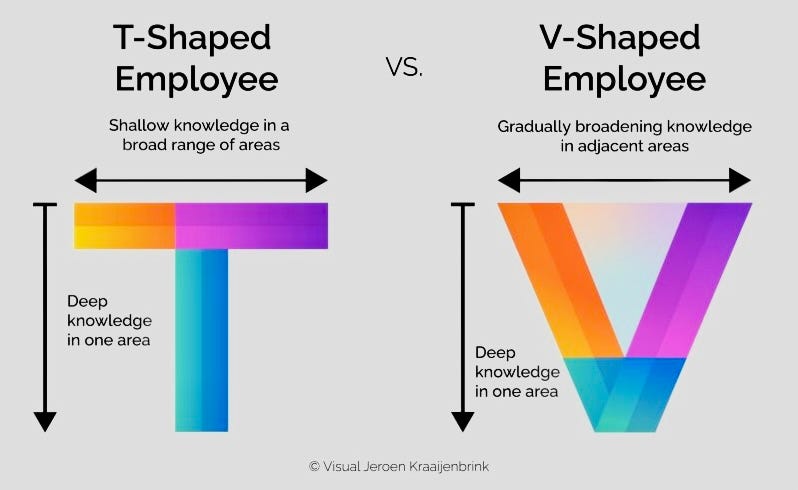
Generalists are often misunderstood as being shallow or unfocused. But today’s generalists are V-shaped thinkers (a concept introduced to me by Jeroen Kraaijenbrink): experts with deep knowledge in one or more areas, complemented by broad, adjacent knowledge across disciplines.
This combination of depth and breadth makes them uniquely capable of addressing complex problems. For example, a V-shaped designer might:
- Pair UX expertise with behavioral psychology to create experiences that resonate emotionally and functionally.
- Combine knowledge of business processes with design to align products with organizational workflows.
- Use data analysis alongside design strategy to deliver evidence-based solutions.
Unlike T-shaped thinkers, whose broad knowledge often remains shallow, V-shaped thinkers continuously deepen their adjacent skills. This enables them to bridge disciplines, thrive in multidisciplinary teams, and drive innovation.
AI Is Elevating Generalists, Not Replacing Designers
And the good thing is: Becoming a v-shaped generalist has never been easier, due to the rise of AI. Tools like ChatGPT, Perplexity, Gemini, MidJourney, Notion AI, and Miro’s integration with Uizard ease tasks like research, ideation, wireframing, usability testing, and persona creation. Even Figma’s anticipated AI capabilities hint at even more disruption.
But AI isn’t replacing designers — it’s amplifying generalists’ strengths. By helping to automate repetitive tasks or get much information with ease, AI allows designers to focus on higher-order challenges, such as:
- Aligning design with strategic business goals.
- Focus way more on identifying the crucial problems. (no more thinking how to create a component, yay!)
- Crafting systems-level solutions that connect multiple disciplines.
Generalists thrive in this environment. They use AI as a collaborator, not a competitor, leveraging automation to think critically, adapt, and deliver innovative solutions.
Building the Future: Generalists Lead the Way
The challenges of today demand designers who can adapt, think holistically, and work across systems. While specialists excel in narrow, well-defined tasks, the greatest impact comes from generalists who bridge disciplines and embrace complexity. Generalists aren’t just the future — they’re the key to solving the design world’s toughest challenges today.